His Life
Early influences in Follansbee and East Liverpool
“In Follansbee, I was introduced briefly to Catholic Schools and the game of Football. The Catholic school did not have enough children to fill the classrooms, so as an active Catholic, Lou attended school a year early.”
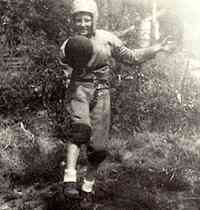
Lou’s first recollection of watching organized football occurred in Follansbee on a fall Saturday when he ventured away from the playground at the park to peer through a chain link fence to see what the people were all excited about. He was interested and stood long enough to get indentations on his face. He was informed by his uncle that they were playing football and it was more advanced than the game we played in the streets. Lou continued to be drawn to the game on those Saturday afternoons.
Not long after this introduction to football, Lou’s father joined the Navy. This forced his mother and the family to East Liverpool to live with her mother. East Liverpool, bordered by the Ohio River, is in the “Ohio Valley” and is known for the pottery produced by the people and businesses in this town. Within twenty-four hours of moving to East Liverpool, he became the happiest child in Ohio when he met his Uncle Lou (Lou Tychonievich), who would become better known as Uncle Junior.
Uncle Junior became his dearest friend and most influential male in his life. Lou had just finished second grade and was at an age where he needed a male influence in his life. With the elder Holtz serving, the responsibility of being the good male image to an impressionable young boy fell to Uncle Junior.

After moving to E. Liverpool, Lou remembered his first impression of Notre Dame. “I went to St. Aloysius Grade School in East Liverpool, and we were taught by the Sisters of Notre Dame. At lunch, recess and dismissal, we marched out to the Notre Dame Victory March. They played it on the juke box in the foyer of the school. Those were my formative years, and those were the years, 1946 - 1950, when Notre Dame never lost a game. The impressions Holtz formed about Notre Dame came about because the people he respected so much, his mother, his father, grandparents and other relatives, held Notre Dame in such high esteem.
“After returning to E. Liverpool following a brief duty in the service, Uncle Junior was in the Army’s 52-20 plan and had some free time. When St. Aloysius asked him to start up and coach their first 7th & 8th grade football team, He accepted on the condition that I would help him. While I was only in fourth grade, I wanted in on the action rather than carrying water and towels around. Uncle Junior gave me a football uniform and I was ready to start and make him proud in the future.”
Although small for his grade, Holtz had to fight his way home from school beyond the wisecracks about the clothes selected for him. Between surviving those fights and playing football against children more physically mature, Holtz learned a lesson that there is a natural aggression in everyone. You are either going to take it out brawling or you can pursue constructive events, like sports.
Holtz says this is a lesson of life. “When you get knocked down and tramped on you have two choices: learn to like being down or get tough and do something about it. You have to pay a price for anything worth having. Part of that lesson came from observing my dad. He worked two jobs to support our family. I’d watch him come home just long enough to take a short nap and eat something before going to his second job.”
Lou continued to play football and before entering high school took over a paper route. “It put a cramp in my practice time and changed my habit of hanging around after practice chewing the fat with the guys, but it was my first step in learning responsibility. I would run every step of the way from the practice field to where my paper bundles were and get started. Most of the time was tedious, but I got to keep 50 cents a week out of what I earned. The remaining six or seven dollars went into the family budget. There was something I noticed about collecting. The ones who paid their bill on time were the ones who had their lives together.”
“Before entering my sophomore year, my parents determined that I would finish high school in the public school. I knew there would be more kids to compete with on the football field and getting a starting job would be tough.”
The town of East Liverpool showed tremendous support for the local high school team. “My sophomore year we were 8-2 and young to boot. Wade Watts was a good coach and a good man, and the next year we went undefeated. The most important thing, I was second string and heir apparent to start the next year.”
“But Coach Watts left for another job after that year and that was when my schooling really began. Before he left, he did something I didn’t find out for a year. It probably wouldn’t have mattered if I had found out then because my head was full of dreams about finally starting, being a cog in the wheel. I was hooked on athletics even then. I loved the challenge of trying to win each year, the challenge of watching a group of young men change from individuals into a well-greased machine with each member of the team an important cam.”
“And on the brink of finding the success that had evaded me for so long, a new coach came onto the scene, Bob Gibson, who later coached at Bowling Green and the New York Giants.”
“I wasn’t worried about having a new coach. I was the heir apparent and would surely be starting. I was ready to set East Liverpool on its ear, and my family was ready to realize some of their dreams of my success, too.”
“Football has always been my family’s favorite sport, and while I played some basketball and baseball, too, I knew football was where I had to prove myself.”
“The summer before my senior year I wanted to get a job in the steel mill, but I wasn’t 18 so I was forced to keep my job wrapping paper bundles. Our normal agenda after work was to hang out and we had never heard of drugs.”
“I had played baseball in the mornings all summer, football in the afternoons, and then worked. I was in good shape. Then Gibson called us together for the first practice. I thought my prayers were finally going to be answered, but at the very first meeting he told us he was going to be rebuilding and looking at a lot of sophomores and juniors.”
“I didn’t even get a chance to start until the season was half over, and even if I do say so myself, I played well the rest of the season. All I needed was the chance, and when I got it, I knew I did my job. I was more proud of myself though for the way I handled the whole thing. People had been telling me they would quit if they were me, but if that thought ever entered my mind for even a split second, I honestly don’t remember it.”
“This coaching change at my high school made me realize two things that I have tried to remember throughout my career. First, I had noticed that if you win, you move up to a better job. Second, I learned that when you take over a job, you owe something to the players who have already been busting their butts for a couple of years.”
“I have taken over five separate college programs and at each school people would ask if I was going to start rebuilding. Every time, I’ve told them I definitely feel the seniors have an obligation due them, and I was going to see that they got paid.”
“When any young man starts a program, he has great hopes of having a great year, at least by the time he is a senior. And I will not cheat him out of the chance to fulfill that dream.”
His career
While on the college campus, Lou Holtz could be mistaken for a music professor rather than a college football head coach. Lou Holtz has composed a symphony of victories everywhere he has coached. He said in his first press conference at North Carolina State in 1971, “I know how I look and I can’t help it. But I can throw a clipboard as good as any coach who’s six foot four, and I like to win.” And during his 27 year head coaching career, win he has. Luckily, we do not judge books or football coaches by their covers, for if we did, Lou Holtz might never have been permitted on a football field as a player or coach. He is quick to admit that he does not resemble the traditional image we conjure of a coach. But that matters not. As Oliver Wendell Holmes eloquently stated, what is important is what’s inside a man, and inside Lou Holtz beats the heart of a winner. On the outside, Holtz is a fast talking perpetual motion machine with a knack for creating enthusiasm and motivating the young men who have played for him.
Although Lou Holtz stepped down as Notre Dame’s head coach following the 1996 season, he prepared many different teams for big contests over his 27 year career. In November, 1993, the Sporting News wrote, “Lou Holtz simply is the best big-game coach in college football today. Let’s go even further. He also must be considered one of the top pressure-situation coaches in the sport’s history. Honest now, who would you rather have guiding your team in a game that would decide the National Title?”
“I’m not in coaching for the money, fame, glory or anything else like that. I got into coaching because I loved athletics and what it could teach a person. I wanted to be the one teaching,” Holtz said. Besides teaching his teams how to play the game of football and win, he has tried to prepare his players for life beyond football. Concerning the values of football, Holtz said, “The closeness that these young men acquire while playing with each other is great. I don’t think you can say this occurs in just college football; it’s what life is all about - as we’ve told the players many times, the only friends you have in this world when things aren’t going well are those you eat with, sleep with, pray with, bleed with, laugh with and cry with. You have to go through an experience with your teammates to understand the closeness that develops; you’re put under all situations - good, bad, exhilarating, and depths of depression - and you develop a friendship as in no other environment except football.” Former Irish linebacker and tri-captain Ned Bolcar recalls the 6 a.m. workouts that Holtz put in place during the 1988 winter workouts. “Starting at 6 a.m. was hell, but it brought us all together. When you’re suffering that early in the morning, who do you look to for camaraderie? The guy next to you.”
Finding his calling
Growing up in East Liverpool, Holtz found a game he loved in football. “While playing football in high school, I used to pray until late into the night. ‘Please God, let me be a good athlete.’ I wanted to be good, to excel and be respected more than I wanted anything else. I’d pray and pray, but he never made me a good athlete.”
Holtz realizes the prayers were answered. “It is funny. I might have been a great player, known a few hours of glory, and been a terrible coach. I realize now that God knew what he was doing. I’ve had the greatest thrills of my life as a coach.”
“It wasn’t until I got into high school that I really began to learn from athletics. I learned that it was important for everybody on the squad to contribute to the success of the team.”
Even though he was far from being the best athlete on the E. Liverpool team, Holtz’s desire to contribute foreshadowed his career calling during one high school game. Lou recalls, “Even in high school, I was a student of the game. After we scored a touchdown in the middle of one game, I got up from the bench, watched the extra point, and then strolled up nonchalantly to our head coach, Wade Watts. Acting as if I was a paid assistant, I casually told him if we scored another touchdown, he should call for a two point conversion, to send so and so down and out, and that he would be all alone. We scored, he tried the play, and it worked. The most important thing that night was I felt like I had contributed, and to me that was more important than actually getting into the game and playing. Just knowing I had done something to aid in the win was enough self-satisfaction for me. That night I knew the players were going to respect me for the call, everyone knew I called it, and almost all of them said something nice about it to me. That was important to me, real important. Next to playing, having the players respect me was most important.”
The respect Coach Holtz earned with his two point call in high school has carried into his coaching career, players and opponents alike. “If I could give our players one thing, it would not be fame or money, it would be respect. But that is something that cannot be given to you, you must earn it from your teammates and your opponents.”
In Lou’s first head coaching job at William & Mary, he guided the team to the only post season appearance in the school’s history. Following that he earned a reputation as one of the country’s finest offensive coaches. In 1973, Bruce Phillips of the Raleigh Times wrote, “If you have something good, whether it be a better mouse trap or a new design for a bow tie, the world will come to you.”
“Obviously, the North Carolina State University football staff has made a find. Or why else would coaches from other schools and biggies like Tennessee, Florida, Georgia and Texas Tech seek out and search the state system. Since Lou Holtz and his coaching core landed at NC State in 1973, the inquisitive have come to Raleigh in everything but covered wagons.”
“Holtz inherited some fine talent when he took the head coaching position, but he didn’t go around with a magic wand tapping guys on the head and making them super football players. He gave them something to work with.”
“And that something is an offense. It may not be absolutely new to the world of college football, but it’s newfangled enough to stir wholesale interest among campus coaches. It’s sort of Lawrence Welk with a few electric guitars.”
At every school he has coached, his offensive teams have set school records. When asked about his offense, Lou is quick to point out that he has never thrown a block. “If you are playing a Lou Holtz led team, you better be prepared to defend the entire field.” Following the Arkansas’ lopsided upset over Oklahoma in the 1978 Orange Bowl. Oklahoma defensive coordinator Larry Lacewell said, “It was the first time I ever feared a coach.”
The 107 goals
Lou Holtz’s belief in goal setting as daily motivation comes from first hand experience and a lesson he learned in 1966. Holtz, 28, had just been hired as an assistant coach to Marvin Bass at the University of South Carolina. Holtz’s wife, Beth, was eight months pregnant with the couple’s third child and Holtz had spent virtually every penny he had in the bank to make a down payment on a house. One month later, Bass resigned as head coach. Overnight, Holtz was unemployed and questioning whether he was in the right profession. In an effort to lift his spirits, his wife gave him The Magic of Thinking Big by David Schwartz. At that time in his life, Holtz says he was not motivated to do much of anything. “There are so many people, and I was one of them, who don’t do anything special with their lives. The book said that you should write down all the goals you wanted to achieve before you died.” Holtz sat down at the dining room table, let his imagination go, got excited and before he knew it , he had listed 107 goals he wanted to achieve in his life. These goals covered all areas of Holtz’s life that he wanted to improve upon, from professionally to parenting to improving his spiritual life.
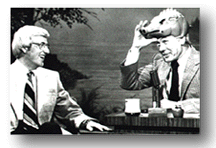
The list included items that seemed impossible in 1966: dinner at the White House, appear on the Johnny Carson show, see the Pope, win a national championship, be Coach of the Year, land on an aircraft carrier, make a hole-in-one on the golf course and jump out of an airplane. “My whole life changed.” What Holtz discovered was the power of positive thinking and setting goals. He tapped into his dreams and figured out exactly what he wanted. His list would become a guideline throughout life and a measuring stick of his success.

Holtz’s philosophy is that reaching for goals, chasing dreams and ideas encourages an individual to be a participant in life. “That is what I say to our athletes and my children, ‘Be a participant, don’t be a spectator.’” At 51 years old, Holtz parachuted out of an airplane. Holtz said, “You don’t do something to say I’m special. I think you want to do things one time because you’ll live the experience a thousand times. Every time I ride in a plane and go up to 10,000 feet, I recall the feeling when those three guys pushed me out after I changed my mind.”
While speaking and doing commentary work for CBS, Holtz has had the opportunity to bring his golf handicap down to single digits. While Holtz doesn’t think he will accomplish his goal to be a scratch golfer, he did achieve another goal. He actually notched a pair of aces in his golfing career. His first came on March 21, 1987 (the day before Notre Dame opened spring practice), by using a four iron on the par-three 170-yard third hole at Elcona Country Club in Elkhart, Indiana. He finished with a 77 that day, despite a double-bogey on the final hole. His second came on May 11, 1988, with a seven iron on the par-three, 147-yard fourth hole at Signal Point in Niles, Michigan. Since recording a hole-in-one ranked as one of the 107 goals he hoped to achieve from the list he compiled back in 1967, the count stood at 81 down, 26 to go.
This account is taken from the biography pages of CoachHoltz.com as they stood in 2000 and 2001, so it speaks in the present tense of that time.
Keep his legacy going
The Holtz Foundation carries Lou’s work forward through scholarships and other giving. A donation helps his example keep reaching people.
Donate to the Holtz FoundationWhere it started
The Lou Holtz Upper Ohio Valley Hall of Fame in East Liverpool, Ohio, honors the people of the valley he grew up in.
Visit the Hall of Fame